
Fueling a yacht in Croatia rarely comes up at the beginning.
You’re planning your route, looking at islands, choosing the yacht, and it feels like something small, something that will simply take care of itself along the way.
In reality, it’s one of the few moments during a yacht charter in Croatia that can quietly shape how your last day feels - especially if the timing isn’t right.
Most delays around fueling don’t come from the process itself, but from the fact that nearly everyone leaves it for the same moment - the final morning.
It’s also something people tend to underestimate, simply because it doesn’t look important until you’re already there.
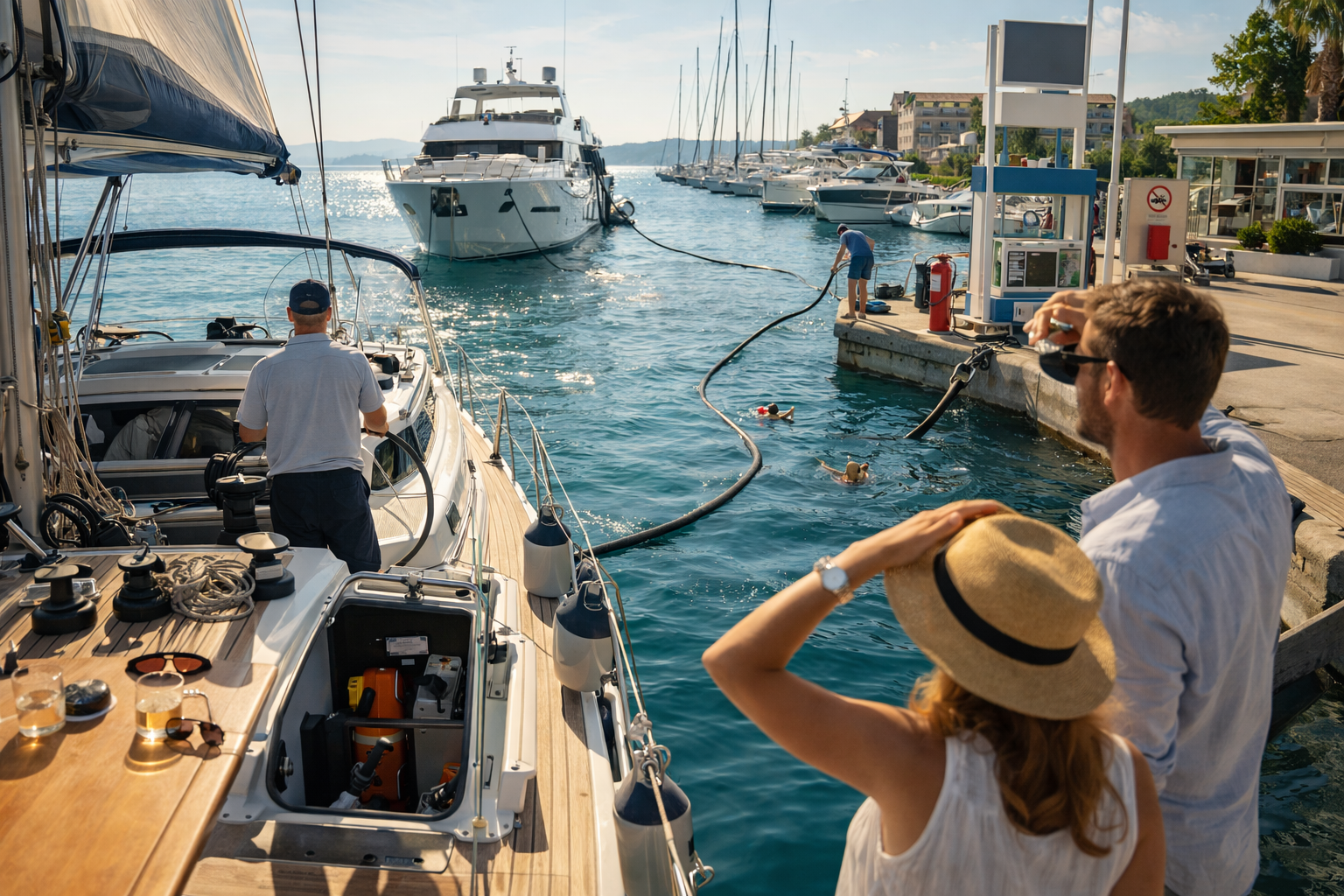
Then, usually towards the end of the week, you find yourself approaching a fuel station just outside Split or Hvar, slowing down behind a few other yachts already waiting, all moving at the same quiet pace, all watching the same single dock.
There’s one hose. One crew finishing slowly. Another yacht joins behind you, and without anyone really saying it, you understand this might take a while.
You glance at your watch, then at the line, then at your skipper, who just shrugs slightly and says, “We’ll see.”
And this is the moment where people realise that something they never thought about is now quietly deciding how their last day will feel.
If you already have your dates and route in mind, this is something we usually plan into the week early, so it never becomes something you deal with at the end.
Fueling a yacht in Croatia - what actually affects it
Before going further, it helps to understand one simple thing that makes everything else clearer.
Fueling during a yacht charter in Croatia depends mainly on three things: where you are, what type of yacht you have, and when you decide to do it.
The location determines how busy the station is, the yacht determines how much time you’ll need, and the timing often decides whether it feels like a simple stop or something that shapes your day.
Once you see it like that, the whole process becomes easier to manage.
Why fueling looks simple - until you’re part of it
On land, it’s automatic, almost invisible. You stop, fill up, and you’re on your way without giving it a second thought.
At sea, especially during high season in Croatia, it follows a completely different rhythm, one that you only really understand once you’re part of it. Most fuel stations are built to handle one yacht at a time, occasionally two, but rarely more, and when dozens of boats are moving through the same areas — Split, Hvar, Vis — everything naturally slows down.
You don’t arrive and refuel.
You arrive, slow down, watch what’s happening ahead of you, and gradually realise you’ve entered a sequence that you can’t really speed up.
The skipper is already watching the dock, trying to read what’s happening, while someone from another boat gestures something that may or may not be meant for you, and almost without noticing it, a line starts forming behind you.
This is where the expectation shifts, not because fueling is complicated, but because you’re now moving at the pace of everyone else.
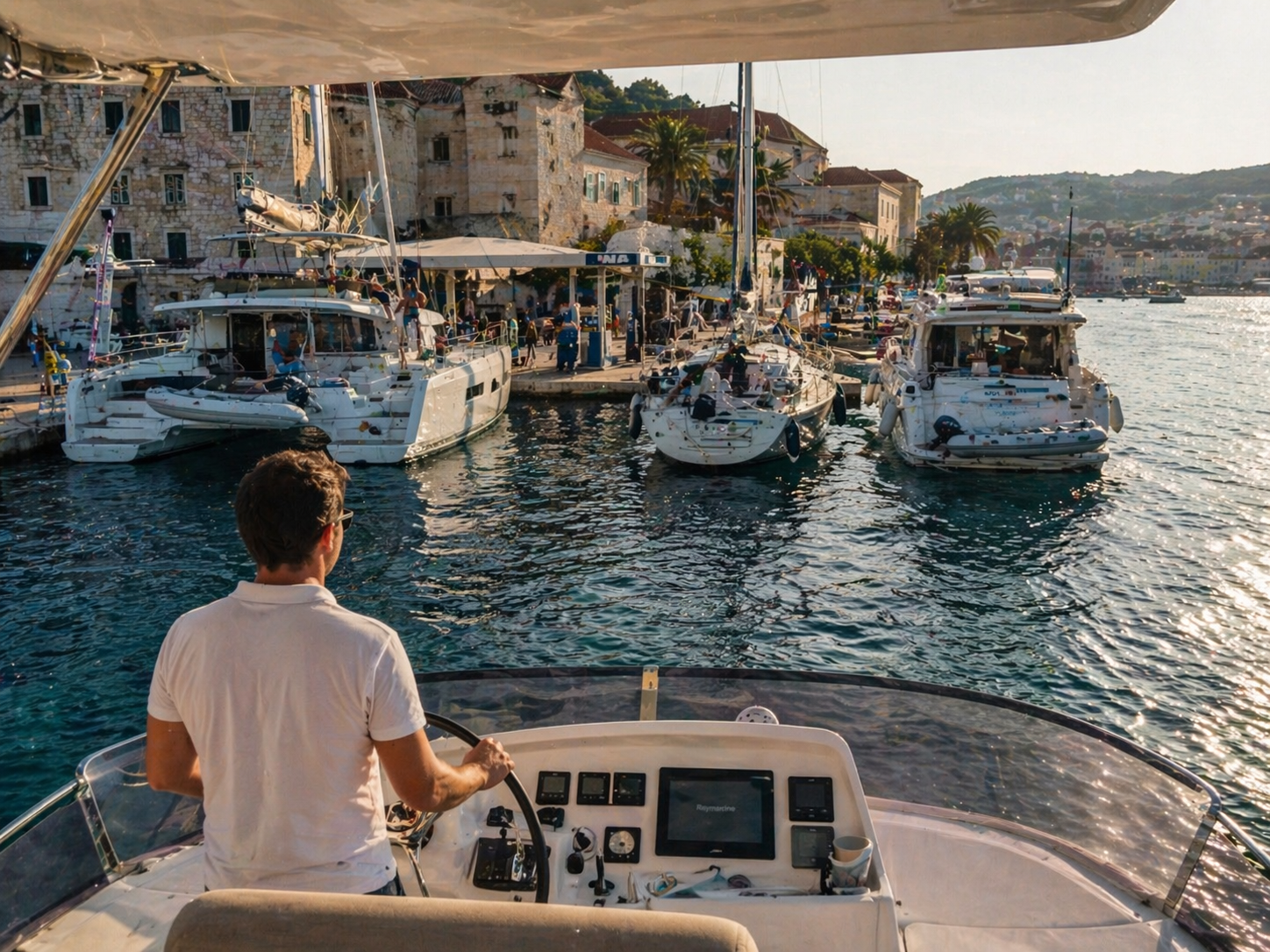
The moment most people remember (even if they didn’t expect to)
It’s not always the longest wait that stays with you, and it’s rarely about the actual time.
It’s more about the feeling of being slightly out of control in a week where everything else has felt easy.
Someone on board casually asks how long this usually takes, someone else suggests grabbing a coffee later, the conversation drifts somewhere else, but every now and then, everyone’s eyes return to the same point — the dock, the hose, the boat in front.
Then a larger yacht approaches and slips ahead, and the skipper quietly adjusts, lets them go first, without even explaining why.
And that’s usually the moment where it clicks - this isn’t something you control anymore, you just move with it.
Where the week subtly changes - and why timing suddenly matters
The first part of the week flows without effort.
You leave Split, find your rhythm somewhere between Brač and Hvar, maybe spend a day around the Pakleni islands or move further towards Vis, and by day two or three, nobody is really thinking about distances anymore.
By day four, you’re not even asking what comes next, because the days simply unfold on their own.
And then, somewhere around day five or six, the thought quietly comes back.
How much fuel is actually left. Whether it makes more sense to refuel today or tomorrow. Whether the station will be busy.
This is where the week shifts, not dramatically, but just enough that timing starts to matter again.
Saturday morning - where everything compresses
If there’s one scene that repeats itself, it’s this one.
Early morning on the last day, with yachts arriving from different directions, some already waiting, some circling slowly, others trying to time their approach so they don’t end up at the very back of the line.
Your skipper is watching quietly, calculating without saying much, while guests become more aware of what’s happening around them, phones come out, someone checks the time again, and the relaxed rhythm of the week tightens just slightly.
No one is stressed exactly, but it no longer feels effortless.
And this is usually when people say, almost automatically, “we should have done this yesterday.”

Motor yacht vs sailing yacht – why fuel timing changes
This is something that only becomes clear once you’ve experienced the difference.
On a sailing yacht, fuel is almost an afterthought, something you use without really thinking about it, because the wind does most of the work.
On a catamaran charter Croatia, it’s still simple, you move comfortably, but you’re not constantly thinking about consumption or timing.
But on a motor yacht charter Croatia, especially something like an Azimut 53, the entire week takes on a different rhythm from the start.
You don’t wait for conditions, you don’t adjust plans around wind, and you rarely hesitate before changing direction, because the yacht gives you the freedom to move exactly how and when you want.
Lunch in one bay, a swim somewhere else, and sunset in a completely different spot becomes the normal flow of the day.
This is where people feel what that freedom really means, and they tend to use it fully.
More movement, more stops, more spontaneous decisions, and by the time you reach day five or six, you realise you’ve seen and done more than you initially planned.
And naturally, that means fuel becomes something you need to think about slightly earlier.
Not as a limitation, but simply as part of how that kind of week works in practice.
If you’re choosing between sailing, catamaran or motor yacht, this is one of those details we can walk through together, because it often becomes clear only when you imagine the full week, not just the boat.
Where fueling is easiest (and where delays happen)
Not all fuel stations feel the same, and this is something people usually only discover once they’re already there.
Split, especially the main fuel dock, is the busiest, and during July and August it’s not unusual to wait 45 minutes or more, sometimes longer on Saturdays when most charters return.
Hvar can feel similar, especially later in the day, because the dock is small and the traffic is constant.
Vis tends to be calmer, not empty, but more manageable, while Šibenik and the northern part of the coast usually sit somewhere in between, where things move steadily without feeling chaotic.
And this is why the exact location matters less than the timing of your arrival.
Early morning or a midweek afternoon can feel completely different from a Saturday morning, even at the same station.
Fuel usage - what it actually means on a yacht like Azimut 53
This is another part that becomes clearer once you’re onboard.
An Azimut 53 typically uses somewhere around 150–200 litres per hour, depending on speed and how you move throughout the week, which sounds significant until you connect it with how the yacht is actually used.
Short distances between nearby islands won’t change much, but once you start moving more freely, stretching your days a little further, choosing locations based on how they feel rather than how close they are, the consumption naturally follows.
Over a week, most clients refuel once, sometimes twice, depending on how much they’ve used that freedom.
And this is where the connection becomes obvious — the more flexible your week feels, the more important it becomes to think about fueling at the right moment, not at the last moment.
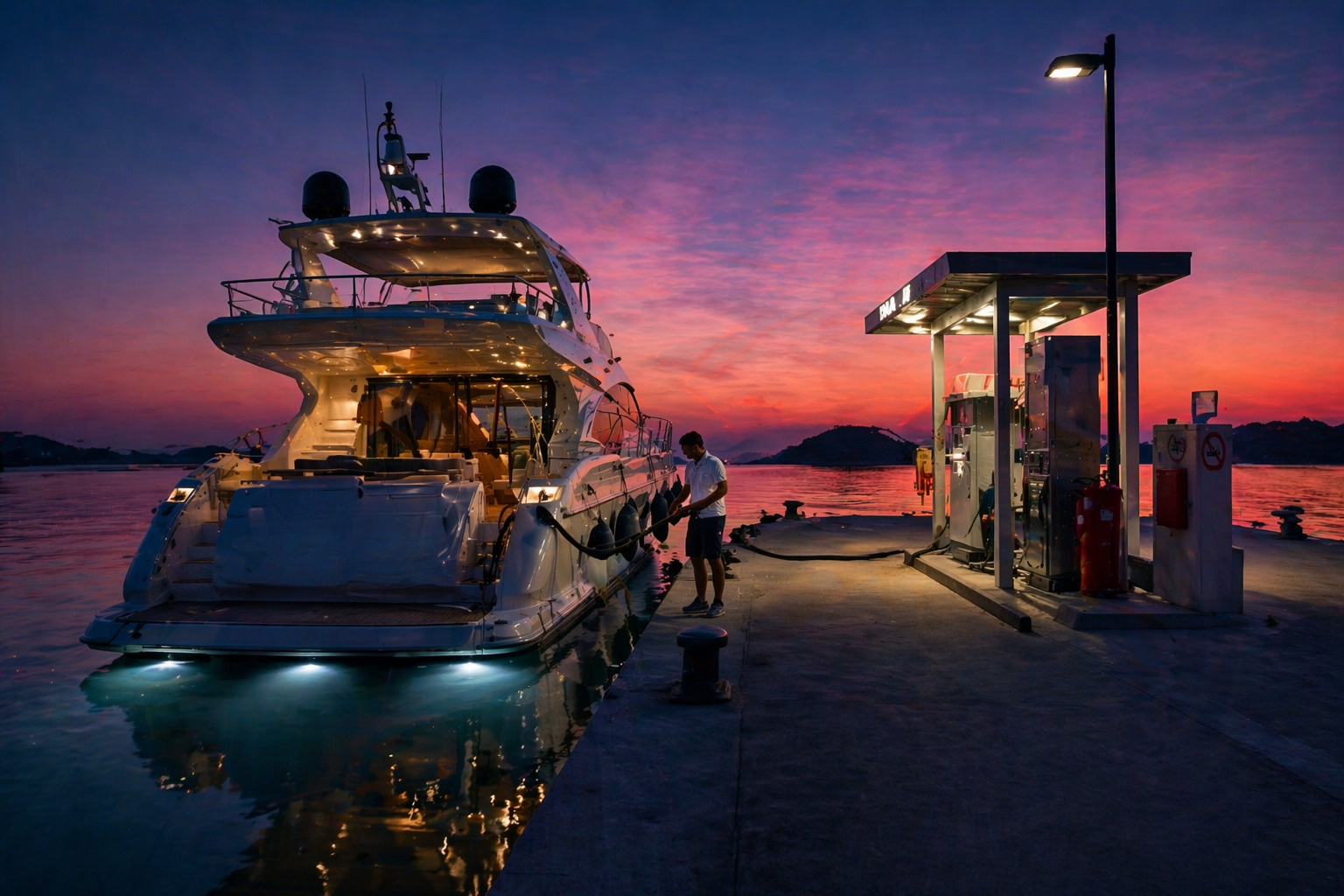
How experienced clients avoid the wait
There’s a very clear pattern that repeats itself.
First-time clients almost always leave fueling for the final morning, because it feels logical to finish everything at the end.
Clients who’ve done it before almost never do that.
They refuel the afternoon before, usually without even discussing it much, when the stations are calmer and there’s no pressure to be anywhere.
And that one decision changes the entire ending of the trip.
The next morning feels like the rest of the week — slow, easy, without time pressure, just a quiet final stretch before returning.
If you want your last day to feel like the rest of your week, we can plan this in advance so it happens naturally, without you needing to think about it.
The part that changes everything - but only if you allow it to
There’s another shift that happens, and it’s less about logistics and more about how you approach the situation.
You don’t have to sit in line.
If a station is busy, you can step back, anchor nearby, and watch from a distance as things clear.
We’ve seen this many times, where what starts as waiting turns into something completely different.
People jump into the water, someone opens a bottle, conversations shift, and suddenly the same situation that could have felt frustrating becomes just another quiet moment in the day.
And this is usually where people realise that it was never really a problem, just something they hadn’t planned for.
What catches people off guard more often than you’d expect
Fuel levels, simply because they’re easy to ignore when everything else is going well.
Then you approach a station, see a line, and realise you don’t have enough flexibility to leave and come back later, which is when something that felt completely open suddenly becomes fixed.
And that’s the moment you want to avoid, because it removes your options.
A quick word on safety - because this part stays simple for a reason
Fueling doesn’t need to be complicated, but it does need to stay calm.
Engines off, no open flames, no unnecessary movement near the tank area, and a bit of attention to what’s happening around you is enough to keep everything exactly as it should be.
Clean, controlled, and uneventful.
What we always tell clients before they go
Fueling is part of the week, but it doesn’t need to become something you think about.
Once you understand when it happens and how it works, it naturally fades into the background, and the difference between a smooth week and a slightly stressful one often comes down to this exact detail.
If you’re planning your yacht charter Croatia, we can walk you through these moments before you even arrive, so everything feels effortless once you’re onboard.
Final thought
You won’t remember your charter because of the fuel stop. You’ll remember how the last day felt.
And when everything is planned properly, it doesn’t feel like the end of something.
It just feels like the last quiet part of a week you’d do again.
Practical questions people usually have
How long does fueling a yacht in Croatia take?
Usually between 15 minutes and over an hour, depending on location and timing. In peak season, waiting time often matters more than the fueling itself.
When is the best time to refuel a yacht?
The afternoon before your final day is usually the easiest, when stations are quieter and there’s no time pressure.
Do all marinas in Croatia have fuel stations?
No. Major locations like Split, Hvar, and Vis do, but availability and capacity vary, which is why timing matters more than distance.