
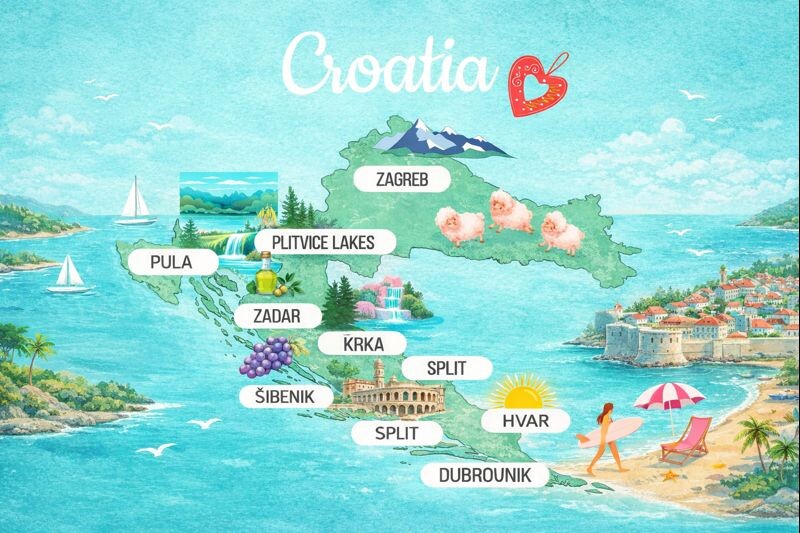
Croatia is a southern European country along the Adriatic Sea, known for its indented coastline, large number of islands, rich culture, and long maritime tradition.
Its shape is often described as unusual — almost boomerang-like — stretching from the eastern Alps and the Pannonian Plain down to the Adriatic coast.
From a map, the coastline appears fragmented. In practice, that irregularity translates into proximity — islands sit close to each other, the mainland is rarely far, and movement between places tends to happen in shorter, more flexible steps.
Locally, Croatia is often referred to through the phrase “Lijepa naša” — meaning “Our Beautiful” — which is also the title of the national anthem. It’s not a formal expression, but a familiar one that reflects how the country is perceived from within.
Croatia has developed a distinct identity over time and today is a full participant in European culture and science. Visitors often notice a combination of factors rather than a single highlight: clean, deep-blue sea, relatively fair prices, picturesque villages, national parks, long sunny periods, and a mix of local food, wine, and social life.
Croatia is a modern country with a combination of Mediterranean and continental climate influences, which contributes to its overall diversity.
The coastline and its structure
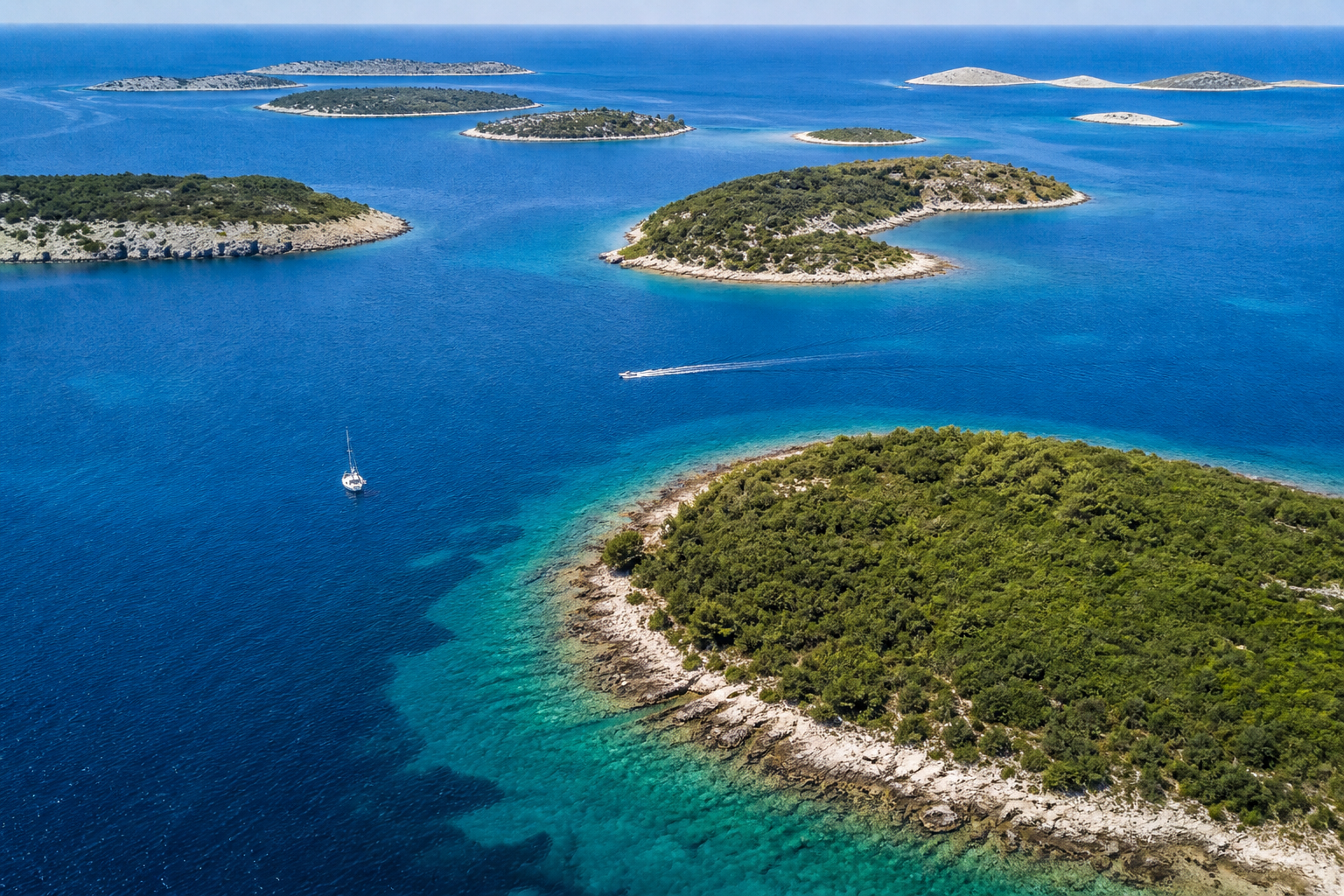
There are more than a thousand islands, but the number itself doesn’t explain much.
What matters is how they are arranged.
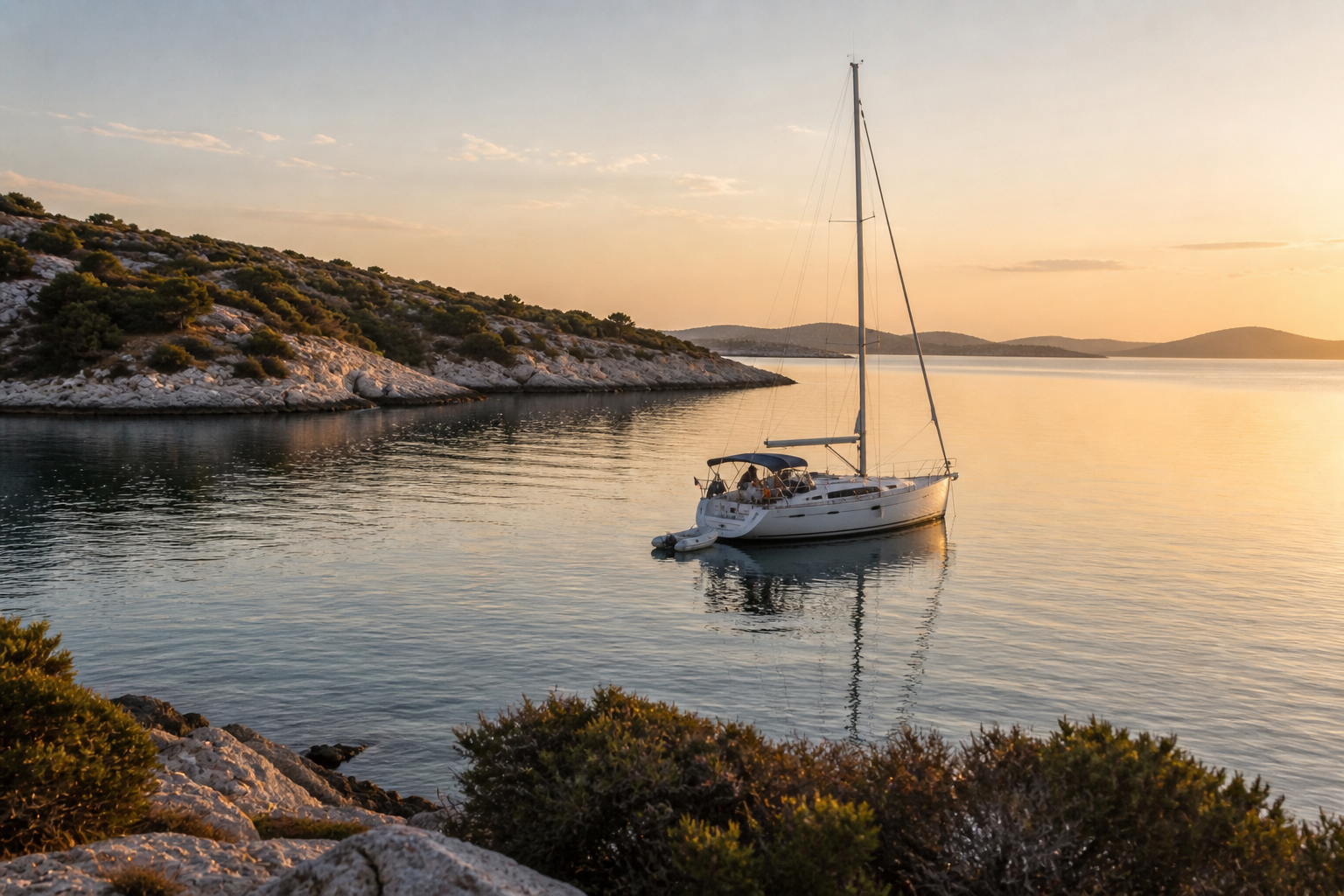
They form clusters rather than being scattered. Channels between them are often short and partially protected. Bays appear frequently, and stopping points are rarely far apart.
This structure shapes how time is spent. Movement tends to happen in smaller segments, with plans adjusting easily because alternatives are always nearby.
Geography within short distances
Croatia connects several distinct landscapes across a relatively small area.
Inland regions open toward Central Europe and the Pannonian Plain, with flatter terrain and continental influence. Moving toward the coast, the Dinaric mountains run parallel to the sea, creating a more defined transition.
Along the islands, the terrain lowers again — rocky, exposed, and shaped by wind and salt.
These shifts appear gradually, often within the same day, without requiring long travel.
Sea, climate, and light
The Adriatic coast has a Mediterranean climate, with hot, dry summers and mild winters.
It is one of the sunniest coasts in Europe, with around 2,600 hours of sunshine per year, and average summer temperatures around 27°C.
At the same time, the sea is not static. Winds such as the bura and jugo can develop quickly and change conditions within hours.
The water is notably clear. With a seabed dominated by rock, sand, and gravel, visibility remains high even close to shore.
Infrastructure along the coast
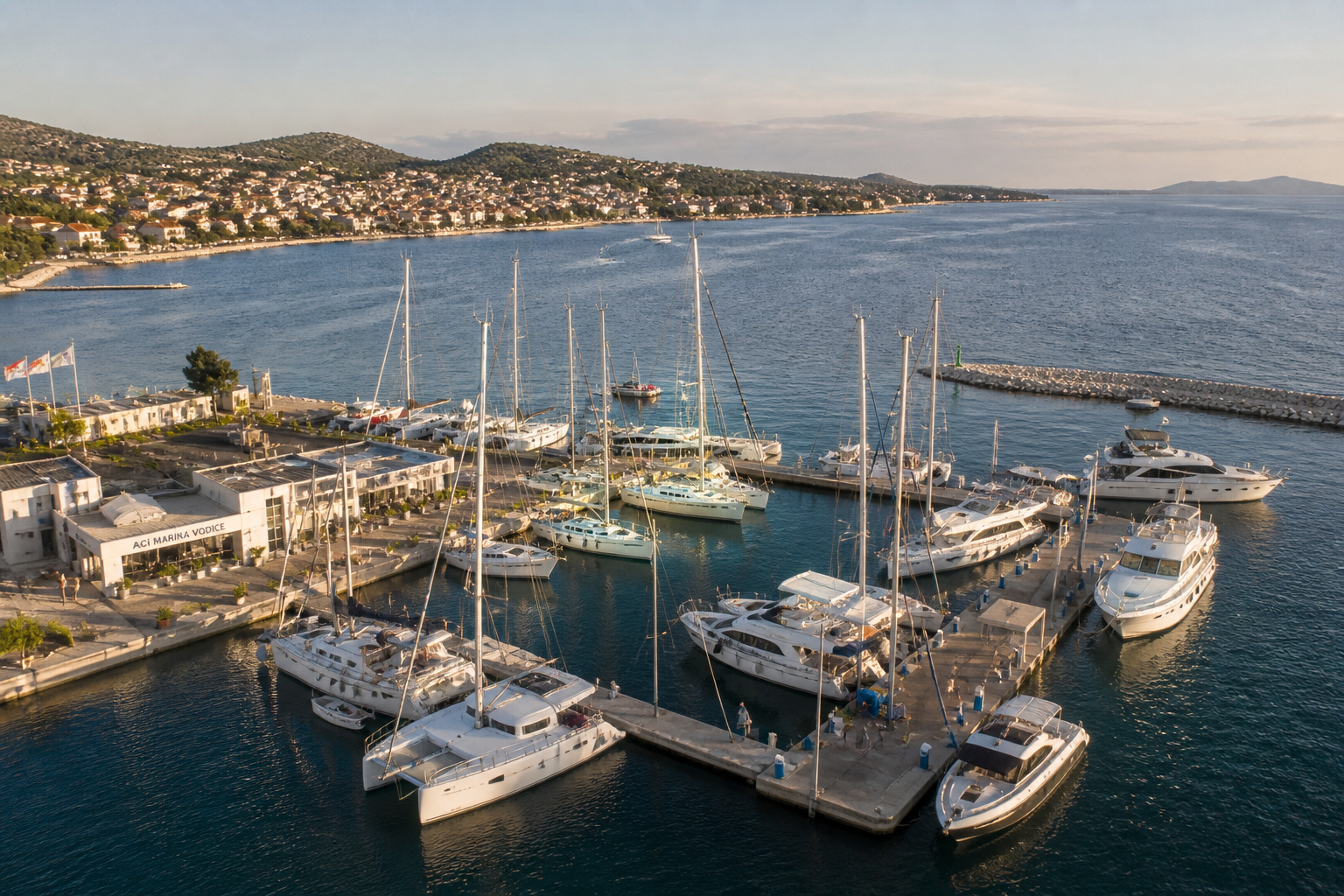
One of the less visible characteristics of Croatia is how evenly infrastructure is distributed.
Marinas, ports, fuel stations, and service points appear regularly along the coastline, without forming a single dominant hub. This reduces dependence on fixed locations and allows movement to remain flexible.
For visitors considering a yacht charter in Croatia, this becomes noticeable once onboard — the coastline supports adjustment rather than forcing decisions.
Charter presence without concentration
Croatia has one of the most developed yacht charter markets in Europe.
Despite this, activity is spread across several regions — Split, Zadar, Šibenik, Dubrovnik — and further dispersed by the islands themselves.
This creates a balance where movement is constant, but not confined to a single area. Some locations become busy at certain times, while others remain quiet at the same moment.
Towns and everyday life
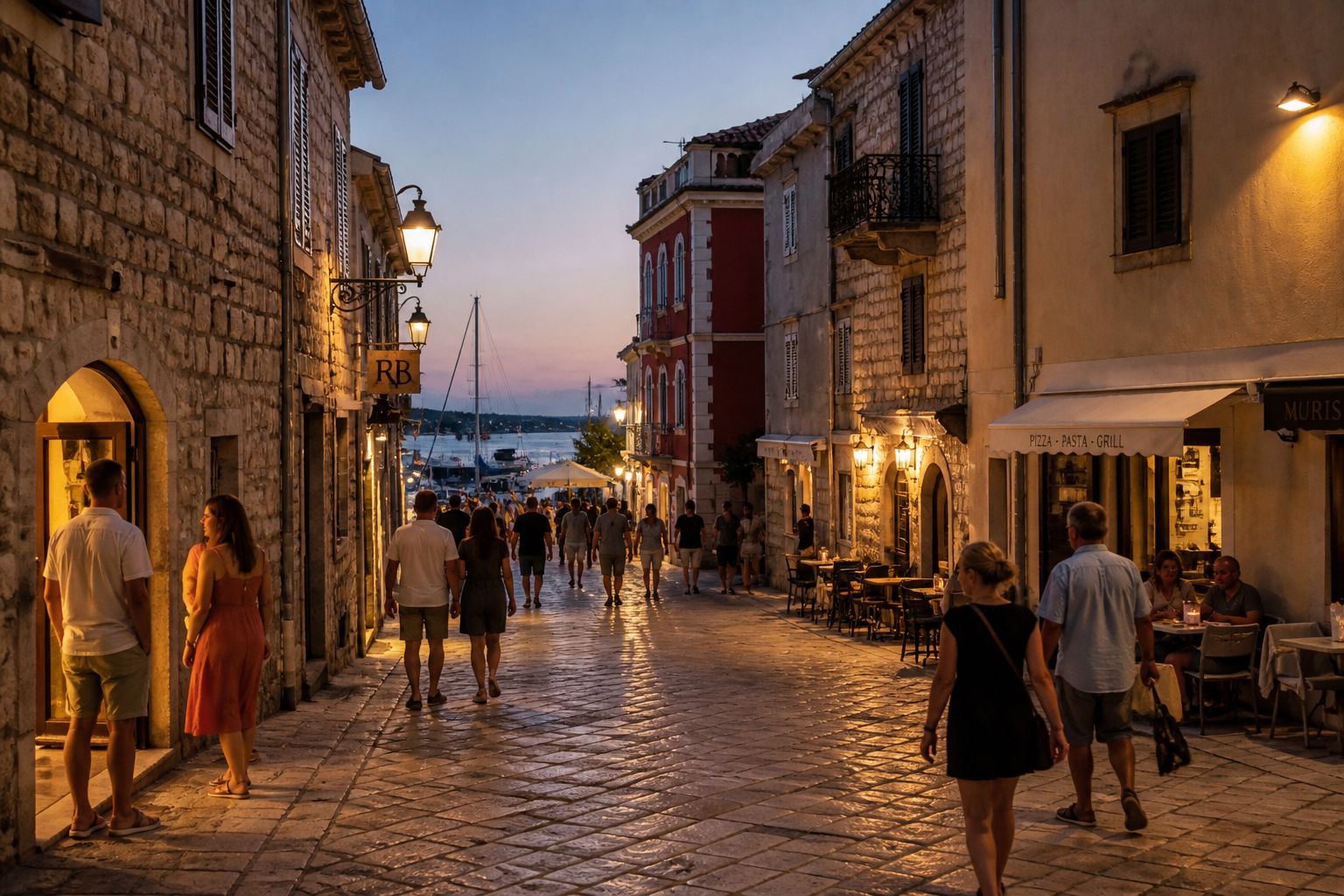
Coastal towns developed over centuries as ports, trading centres, and defensive settlements.
Their structure reflects that history — narrow streets, irregular layouts, and buildings adapted over time.
Cities like Split or Dubrovnik are often seen as historical landmarks, but they remain active environments where daily life continues alongside tourism.
General information about Croatia
Geographical position
Croatia is situated in the heart of Europe, stretching from the foot of the Alps in the northwest and the Pannonian Plain in the east, across the Dinaric mountain range to the Adriatic Sea in the south.
Its shape is largely the result of historical developments, including centuries of Ottoman expansion toward Central Europe, although Croatia itself was never conquered by the Turks.
Surface area
- Land: 56,542 km²
- Territorial waters: 31,067 km²
Population
- Approx. 3.8–4 million inhabitants
- Over 90% Croats (majority Roman Catholic)
- Minorities: Serbian, Bosnian, Hungarian, Italian
Climate
- Coastal: Mediterranean (hot, dry summers; mild winters)
- Inland: Continental (warm summers, cold winters with rain and snow)
Number of islands
- 1,185 islands, islets and reefs
- 67 inhabited
- Largest: Krk and Cres
Capital
- Zagreb (administrative, cultural, academic centre)
- Population: approx. 960,000
Religion
- Predominantly Roman Catholic
Official language and alphabet
- Croatian language
- Latin alphabet
Political system
- Parliamentary democracy
National holidays
- January 1 – New Year’s Day
- January 6 – Epiphany
- Easter Monday
- May 1 – Labour Day
- Corpus Christi (movable)
- June 22 – Anti-Fascist Struggle Day
- June 25 – Statehood Day
- August 5 – Homeland Victory Day
- August 15 – Assumption
- October 8 – Independence Day
- November 1 – All Saints’ Day
- December 25–26 – Christmas Holidays
Practical travel information
Currency
- Euro (€) (replaced Croatian Kuna)
Foreign currency can be exchanged in banks, exchange offices, post offices, tourist agencies, and hotels.
Credit cards
Most hotels, restaurants, and shops accept:
- American Express
- Diners Club
- MasterCard
- Visa
Electricity
- 220V, 50 Hz
Water
- Tap water is drinkable throughout Croatia
Telephone and connectivity
- Country code: +385
- Mobile phone communication is available throughout Croatia
Time zone
- GMT +1 (summer GMT +2)
Shopping
Common purchases include:
- leather goods
- handmade lace and embroidery
- ceramics
- herbal brandies
Opening hours:
- approx. 7:30 / 8:00 – 20:00
- Saturdays shorter hours
- extended hours in tourist areas during summer
- some shops close during lunch
Duty-free shops are available at airports.
Working hours
- Shops: approx. 8:00 – 20:00
- Saturdays: until 14:00–15:00
- Public services: 8:30 – 16:30 (Mon–Fri)
- Many shops open Sundays in summer
Tax refund for foreign visitors
Tourists can reclaim VAT (PDV) on purchases above a certain value.
Process:
- request PDV-P form
- verify at customs
- refund processed via retailer
Pets
Pets may enter Croatia with:
- valid vaccination record
- veterinary certificate (not older than one year)
Medical services
- Hospitals and clinics in all major cities
- Pharmacies in tourist areas
Croatia is part of the European medical assistance system. Emergency care conditions depend on international agreements.
Postal services
- Post offices: approx. 7:00 – 20:00, Saturdays until 13:00
- Stamps available at post offices, kiosks, and hotels
- Courier services: DHL, TNT
Culture and heritage
Croatia has:
- 4 opera houses
- 29 theatres
- 151 museums and galleries
- 147 cinemas
Cultural and historical monuments
- Amphitheatre in Pula
- Diocletian’s Palace (Split)
- Dubrovnik Old Town
- Romanesque towns: Krk, Rab, Pag, Korčula, Trogir
- Euphrasian Basilica (Poreč)
- St. Donatus (Zadar)
- Cathedral of St. James (Šibenik)
Major cultural events
- Dubrovnik Summer Festival
- Split Summer Festival
- Zagreb Summer Festival
- International Children’s Festival (Šibenik)
- Sinjska Alka
- Varaždin Baroque Evenings
- Vinkovci Autumn
- Istrian Cultural Summer
Entertainment
- Nightclubs and discos in tourist areas
- Summer terrace events
- Live performances and festivals
Casinos
- Around 15 casinos in Croatia
- Located in Zagreb, Split, Hvar, Opatija, Makarska and others
Souvenirs
- Handmade crafts
- ceramics
- local food and drink products
What defines Croatia as a destination
Croatia is not defined by a single feature.
What tends to stay with visitors is how easily everything connects — distances, movement, and daily logistics rarely require complex planning.
Structure exists, but it remains in the background.
If you’re planning to explore Croatia, share your timeframe and starting point with us — we can outline how the coast works in practice and how to approach it.