

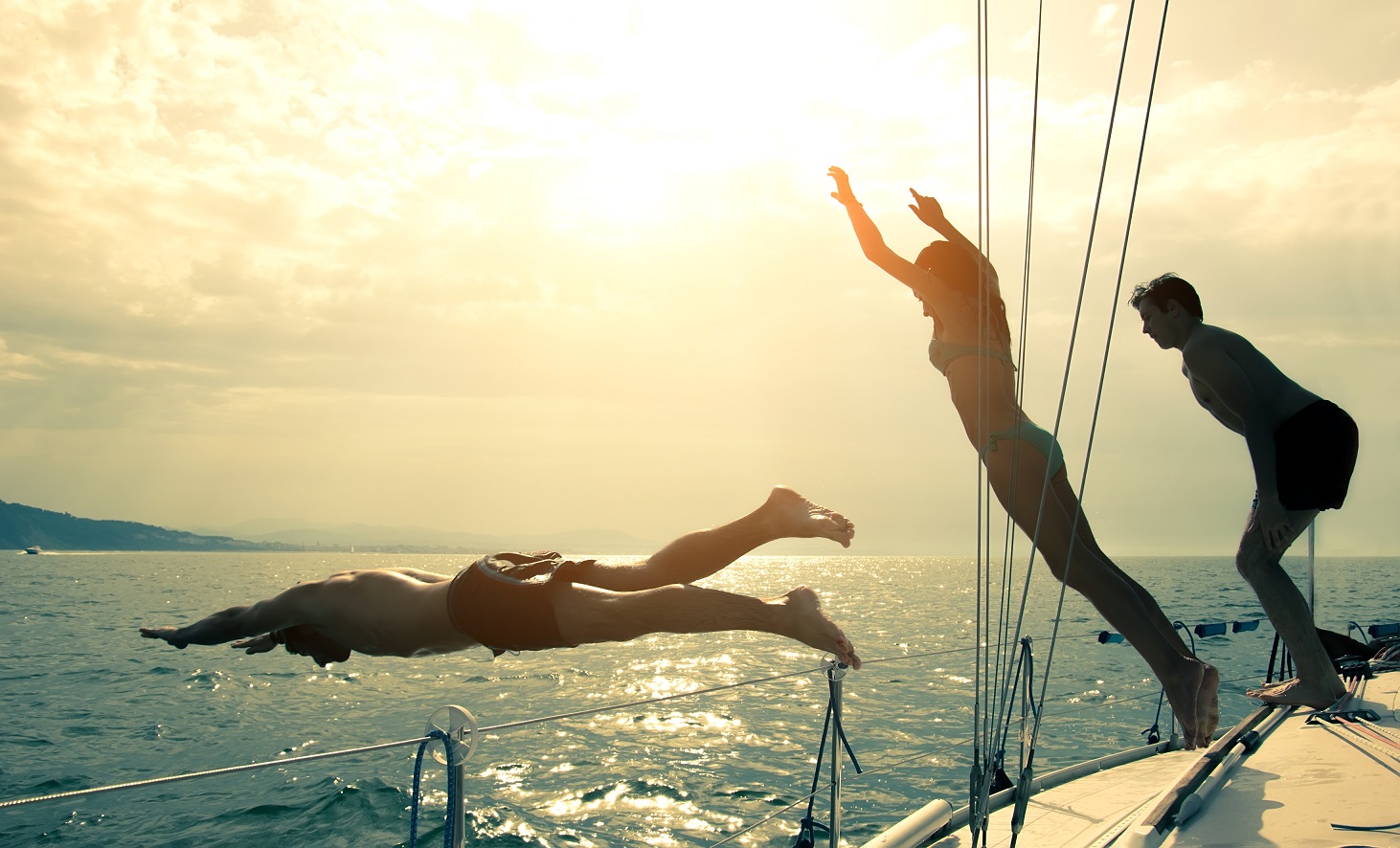
Most people arrive with a slightly wrong picture in mind.
They expect constant movement, fixed plans, maybe even a sense that each day needs to be used efficiently because everything is new.
The first change happens quickly.
Within a day or two, that structure starts to loosen. Plans become suggestions. Distances matter less. The day is no longer something you organise in advance, but something that takes shape gradually — often later than expected.
Mornings start in a quiet bay, often surrounded by low, rocky islands with very little shade except a few pine trees. The water is clear enough to see the seabed, and the next island is usually already in sight.
Most routes along the Croatian coast follow short distances between places like Split, Hvar, Vis or Brač. That alone changes how the week unfolds.
Once that rhythm becomes clear, the rest of the experience starts to fall into place.
Does this kind of trip actually suit you?
For most people, the question is not whether it looks good — it’s whether it fits the way they like to travel.
Some prefer structure and fixed plans. Others are more comfortable when the day stays open and adjusts as it goes.
A week on the water tends to work best for the second group, even if they don’t realise it at first.
The first two days don’t quite settle
The beginning is rarely smooth, and that’s part of it.
People are still thinking ahead. What time to leave. Whether there’s time for another stop. If it makes sense to go somewhere slightly further.
Even small decisions can take longer than expected. Not because they’re difficult, but because everyone is still carrying habits from more structured trips.
You’ll see it in simple moments. Someone suggesting to leave early “to fit more in”. Someone else wanting to stay, but not quite sure if that’s the right call.
Then, usually after the second or third anchorage, something changes.
The questions become simpler. Not “what’s next?” but “do we actually want to move now?”
That’s when the week starts to feel natural.
A normal day is quieter than expected
There is less “activity” than most people imagine.
Most days include one or two shorter legs, usually between one and three hours. The rest of the time is spent stopped — swimming, reading, eating or going ashore.
A typical day might start in a small bay on the south side of Hvar, with calm water and almost no wind in the morning. Later, you move along the coast, pass a few similar coves, and stop again before heading toward a small harbor on Vis or another nearby island.
What fills the day is rarely planned in detail.
Sometimes it’s as simple as staying longer in the water than expected. Other times someone brings out a paddleboard or snorkeling gear, and the stop stretches naturally. If the boat has a tender, it often becomes a way to reach a nearby beach or a small place just around the corner.
There’s no clear line between “activity” and “doing nothing”. One often turns into the other.
Coffee stretches longer than planned. Lunch happens when it happens. Someone is always in the water, someone is always doing very little.
At some point during the week, there’s usually a moment that stays with people.
Not something planned — just a simple situation. Late afternoon, the boat is still, the light is softer, no one is in a hurry to go anywhere. Someone is in the water, someone is half-asleep in the shade, and nothing feels like it needs to change.
By the end of the day, it can be difficult to list everything you did.
But the day doesn’t feel empty.
Movement is present, but not urgent
One of the biggest misconceptions is how much time is spent moving.
In reality, distances along the Croatian coast are short. You are rarely out of sight of land, and often the next stop is already visible while you are still anchored.
On a sailing yacht, the pace follows the wind and tends to feel more connected to the sea. On a catamaran, movement is steadier, and time at anchor becomes more noticeable because of the space onboard. On a motor yacht, it’s possible to reach further points when needed, but most of the time there is no reason to.
Because everything is close, there is no pressure to move for the sake of it. If a bay works well, you stay. That might mean swimming longer, exploring the shoreline, or simply not leaving when you first thought you would.
Space onboard is used differently than people expect
Layouts matter less than behaviour.
A catamaran might offer more space, a sailing yacht might feel more connected, a motor yacht might separate areas more clearly — but people tend to use all boats in similar ways.
There’s always a place where people gather without planning to. Usually somewhere in the shade. Conversations come and go. Someone reads. Someone disappears for a while and comes back without explanation.
No one really uses the boat the way it looks in photos.
They just settle into it.
The quiet moments carry more weight than expected
Some of the most characteristic parts of the week are also the least visible.
Waiting for the anchor to settle.
Waiting for someone to come back from a swim.
Waiting before leaving, even though you could leave earlier.
These would normally feel like delays.
Here, they don’t.
In the late afternoon, when the wind drops, you often hear almost nothing — just water against the hull and, occasionally, cicadas from the shore.
Even the quieter parts of the day are rarely empty. Someone is in the water, someone is preparing something simple to eat, someone is doing very little on purpose.
Those moments stretch the day more than anything else.
Places change easily, but not constantly
The coastline does most of the work.
You don’t need to plan long routes. Everything is within reach. A different bay, a small harbor, another island — all without committing to a long day.
Small towns are part of that movement. You might arrive in the late afternoon, walk a few streets, and sit down at a restaurant close to the water.
Some evenings are simple — just a table, a view and whatever is available that day. Others happen during small local events or among people already there.
Nothing feels organised, but it still feels complete.
At the same time, there is no pressure to move.
Some places get repeated. A bay that worked well on the way out might be visited again on the way back.
The week doesn’t feel like a sequence of stops.
It feels continuous.
Time together becomes simpler
Shared time happens without much effort.
Meals aren’t events. They happen when people are ready. Movement is short enough that it doesn’t interrupt the day.
At the same time, there is always enough space for people to step away.
A different part of the deck. A quiet corner. A short walk ashore.
No one needs to organise this balance.
It just appears.
You can stay connected or step away completely
Some evenings are spent in towns.
You tie up, go ashore, walk a little, sit somewhere for dinner. There’s movement, people, a sense of being part of something.
Other evenings are completely different.
You stay at anchor. No background noise, no passing crowds. Just the boat and the shoreline.
There’s no fixed pattern.
Each day adjusts to what feels right at that moment.
The shift most people don’t expect
After a few days, something subtle changes.
Time stops being divided into “before” and “after”. There’s less thinking about what comes next.
Decisions become smaller. Not “where do we go tomorrow?” but “should we move later?”
People stop checking the time.
Nothing dramatic happens, but the structure of the day becomes very simple.
Practical details that quietly matter
Most routes in Croatia stay within protected waters, which keeps conditions manageable.
Weather still matters, but it rarely stops the week — it just redirects it slightly.
For most groups, a skipper takes care of navigation, docking and safety decisions, so no prior sailing experience is required.
Many boats also carry simple equipment — snorkeling gear, paddleboards or a small tender — which makes it easy to explore without planning anything in advance.
Not everything goes exactly as planned, and that’s usually part of the experience rather than a problem.
Once these basics are clear, everything else becomes easier.
A week on the water in Croatia is not defined by how far you go, but by how little needs to be fixed in advance.
Short distances, flexible plans, and a steady rhythm shape the experience more than any individual place.
Once that becomes clear, the whole idea stops feeling complicated — and starts feeling natural.
If you’re trying to understand whether this kind of week fits you, it usually helps to look at a few real options — different boats, routes and starting points.
Once you see how yacht charter in Croatia actually works in practice, the decision tends to become much simpler than expected.
Do you need sailing experience in Croatia?
No. Most charters include a skipper who handles navigation and docking.
How much time do you spend moving each day?
Usually between one and three hours, depending on the route.